By the time Dirk sat in an interview room at the Charlottesville police station, two hours had passed since the delivery truck disappeared from the alley. Much of that time had been spent telling the story—first to a uniformed officer at the scene and then, in greater detail, to Detective Quinn, the broad-shouldered man who had followed them across the buildings.
Someone had found Dirk a pair of blue disposable slippers that were two sizes too small. Rose sat beside him with an ice pack pressed against her knee while Quinn reviewed the notebook pages he had filled as he listened to their account. A wall clock announced each passing second with more authority than the room required.
When he reached the end of his notes, he looked across the table.
“The woman who called herself Elena is Marta Salazar.”
Dirk remembered the name Quinn had shouted in the alley and the half step the woman had lost before continuing toward the truck.
Quinn explained that Marta and Mateo were suspected of stealing eleven loose, cut-and-polished Colombian emeralds from a private shipment bound for a dealer in Washington, D.C. Together, the stones weighed 27.3 carats and were insured for six hundred thousand dollars. They had been arranged in a narrow protective sleeve that could be folded small enough to conceal in a hand.
Police had been watching the restaurant because Mateo worked in the kitchen and investigators believed he had hidden the emeralds somewhere inside. They expected Marta to retrieve them that afternoon. What they had not expected was a handwritten message inside a fortune cookie.
“The note was part of their plan,” Quinn said. “They knew we were watching the exits, so they needed confusion behind the building. A frightened customer running into the alley, calling for help or confronting an employee would give them that.”
“You mean they hoped someone would find it?” Rose asked.
“They put notes in several cookies. Yours was simply the one that worked.”
Dirk remembered the torn piece of paper and its two desperate words. “Why pretend she was being held prisoner?”
“Because decent people behave predictably when they believe someone is in danger. They stop asking questions, take risks they would ordinarily avoid and become difficult for the police to ignore. Once you appeared on that platform, I had to divide my attention between two suspects and two civilians who had no idea what they had entered.”
Rose lowered the ice pack. “We thought you were chasing us.”
“I was trying to stop you.”
“You might have said you were a police officer.”
“I did. Between the kitchen equipment, the refrigeration unit and the distance between us, I don’t think you heard me.”
Dirk shifted in the plastic chair. The slippers pinched his toes. “Did they have the emeralds when they left?”
Quinn looked at his feet. “When your shoe fell into the alley, did Mateo pick it up?”
“Yes.”
“How long did he have it?”
“Less than a minute.”
“And after he returned it, did anything feel different?”
Dirk remembered the unfamiliar ridge pressing against the inside of his arch. He had blamed the ladder, the fall and his imagination.
“There was something beneath the arch.”
Quinn leaned back. “Then your shoe may have carried six hundred thousand dollars out of the restaurant.”
The sentence took several seconds to settle over the room.
“You think he put the emeralds inside it?” Rose asked.
“We believe the stones were arranged in a narrow chamois sleeve and wrapped in thin plastic. Mateo could have opened the lining along the arch, pushed the packet into the space beneath it and pressed the material back into place.”
“But he couldn’t have known I would give the shoes to her,” Dirk said.
“No. He probably expected Marta to take them from you after you had carried them beyond the restaurant and through everyone watching the exits. The broken glass provided a better opportunity.”
Dirk remembered Marta collapsing beside the gate. He remembered looking for blood and not finding any. More than anything, he remembered how quickly she had stopped limping once she was wearing the shoes.
“So the cut was staged.”
“Most likely. The bruise may have been real. People sometimes assume that a real injury proves the truth of the story attached to it. It does not.”
Rose stared at the ice pack resting across her knee. “We were trying to help her.”
“I know,” Quinn said. “That is why the plan worked.”
Quinn closed his notebook. “Do you still have the note?”
Rose reached into her pocket and removed the two folded slips of paper she had carried from the restaurant. Quinn separated the handwritten message from the printed fortune, placed the note inside a clear evidence sleeve and returned the fortune to her. Rose folded it along its original crease and slipped it back into her pocket.
When Dirk and Rose finally left the police station, the sun had fallen behind the buildings and the streetlights had begun to glow. Dirk’s borrowed slippers slapped against the sidewalk with each step while Rose walked beside him, carrying the melting ice pack against her knee.
Beneath the first streetlight, Rose stopped and removed the fortune Quinn had returned to her. She unfolded it and read the sentence again, this time with the afternoon’s events gathered behind every word.
“Do not mistake temptation for opportunity.”
“I remember,” Dirk said.
“I believe this may have been intended for you.”
“I believe I have received enough wisdom from Chinese food for one lifetime.”
Rose smiled. It was the first time she had done so since they entered the alley. “You still owe me lunch.”
“I paid for the first one.”
“I meant another lunch—one that doesn’t end with a police interview.”
Dirk looked at her. “Is that something you would consider?”
“Yes,” she said. “But perhaps we should try Italian.”
The refrigerated delivery truck was discovered later that evening behind an abandoned warehouse. Its ignition had been wiped clean, and the restaurant uniforms Marta and Mateo had worn were folded on the front seat. Mateo’s black work shoes were found at the bottom of a nearby dumpster. The green suede shoes were not inside the truck, the warehouse or any of the surrounding buildings.
Quinn called Dirk and Rose whenever the investigation produced something worth reporting. During the first several weeks, they used those calls as reasons to see one another. Their second lunch involved no secret messages, rusty ladders or suspected kidnappings. The third consisted of sandwiches eaten on a park bench, and their fourth began at Burke’s bookstore, where Rose found Dirk standing in the same aisle in which they had met. Before long, Quinn’s calls became less frequent, and Dirk and Rose stopped requiring an update as an excuse to spend time together.
Rose continued to grieve her father. Dirk did not attempt to explain the loss, diminish it or fill the place the man had occupied in her life. He listened when she wanted to talk about him and remained nearby when she did not. Dirk discovered that Rose laughed easily when she was not being pursued across rooftops, and Rose learned that Dirk’s courage appeared less often as confidence than as an unwillingness to leave someone alone when he believed that person needed him.
By autumn, they had become a couple, although neither could remember the conversation in which the decision was made. The relationship formed quietly between bookstore visits, long walks and meals during which the only messages inside the fortune cookies had been printed by a machine.
The investigation remained open. Marta and Mateo seemed to have disappeared, and no trace of the emeralds was found.
The answer had already begun before Dirk and Rose shared their second lunch.
The cargo compartment lurched as Mateo accelerated away from the alley behind Yuan Ho in Charlottesville. Marta caught one of the hanging door straps, pulled the rear door closed and secured the latch. The frightened expression she had worn for Dirk and Rose disappeared before their voices finished fading behind her.
She sat on the floor, removed the oversized green shoes and held them in her lap while the truck moved through traffic.
The truck had been waiting since before sunrise. Mateo had rented it two towns away under an assumed name and backed it into the restaurant’s loading area before his shift began. With its rear doors open and the refrigeration unit running, it looked like one more delivery vehicle waiting to be unloaded.
Mateo did not see the shoes again until they reached the abandoned warehouse. When he opened the rear door, Marta handed them to him. Before removing anything else, he pressed his thumb against the lining along the inside arch of the left shoe. The packet remained exactly where he had placed it.
“All eleven,” he said.
Then he removed his black kitchen shoes and tried on Dirk’s. The fit was not exact, but it was close enough. He tightened the laces, stood and took several steps across the warehouse floor.
“They’ll do.”
Marta and Mateo changed clothes and vehicles. By midnight, their restaurant uniforms were folded on the truck’s front seat, Mateo’s black shoes rested at the bottom of the dumpster and the two of them were traveling toward Washington Dulles International Airport under names belonging to people who did not know their identities had been borrowed.
They reached the airport the following morning.
At the security checkpoint, Marta passed through first. Mateo followed until an officer pointed toward his feet and instructed him to remove the shoes. He untied them, placed them directly on the X-ray belt and watched them disappear through the rubber curtains.
The bin stopped inside the machine.
An operator leaned closer to the screen. The belt moved backward several inches, paused and then carried the shoes forward again. Mateo stood barefoot on the other side of the metal detector while another passenger collected a laptop and a child complained about having to remove his jacket.
The operator studied the screen for several more seconds.
Then the bin emerged.
Mateo retrieved the shoes, put them on and retied the laces. He did not look at Marta until they were walking toward the gate.
They landed in Liberia that evening after changing planes in Atlanta. Mateo had worn the green suede shoes throughout the journey, removing them only at the security checkpoint in Dulles. After renting a car, they drove the short distance to Playa Hermosa and registered at a small hotel under the names printed on passports belonging to two people who had never heard of them.
The following morning, less than forty-eight hours after the delivery truck disappeared from the alley behind Yuan Ho in Charlottesville, Marta and Mateo walked onto the beach.
They parked away from the larger groups of visitors and followed the water beyond the families gathered near the shore. Mateo walked ahead while Marta occasionally looked back toward the road. They continued toward a formation of dark rocks where the surf struck with enough force to discourage conversation and the curve of the shoreline concealed them from the parking area.
Between the rocks, Mateo sat and removed the green shoes. Grime from the Charlottesville alley still marked the white soles, but the suede now carried evidence of airport floors, rental cars and roads far beyond anything Dirk had imagined when he purchased them.
Marta took a folding knife from the canvas bag. She worked the blade beneath the lining along the inside arch of the left shoe and opened the seam Mateo had made in the restaurant. When she inserted two fingers, she withdrew a slender packet wrapped in thin plastic.
Inside were eleven cut-and-polished emeralds, each resting in its own fold of a narrow chamois sleeve. Together, they weighed only 27.3 carats—less than a fifth of an ounce—but had been insured for six hundred thousand dollars.
Marta lifted one toward the morning sun. Light entered through its broad table and returned from its carefully cut facets in a green far deeper than anything surrounding it.
She returned the stone to its place, folded the sleeve and concealed the packet inside the canvas bag. Mateo put on a pair of sandals he had carried with him, and they left the green shoes where the rising water met the rocks.
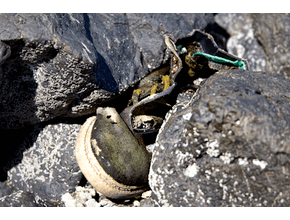
A wave reached them before Marta and Mateo returned to the car. The right shoe was pulled into the surf and disappeared. The left became wedged between two stones, where the water rinsed away the last traces of the Charlottesville alley and pushed sand into the opening beneath its arch.
It remained there until a man celebrating his twentieth wedding anniversary noticed it and began to wonder how it had arrived.
The woman had never needed to be rescued.
She had needed a courier.
The message in the fortune cookie had not been a plea.
It had been an instruction.
Until next time,
George
If this reflection brought someone to mind, perhaps share it with them. If you enjoyed it, I hope you’ll stay awhile, read a few more and consider subscribing.