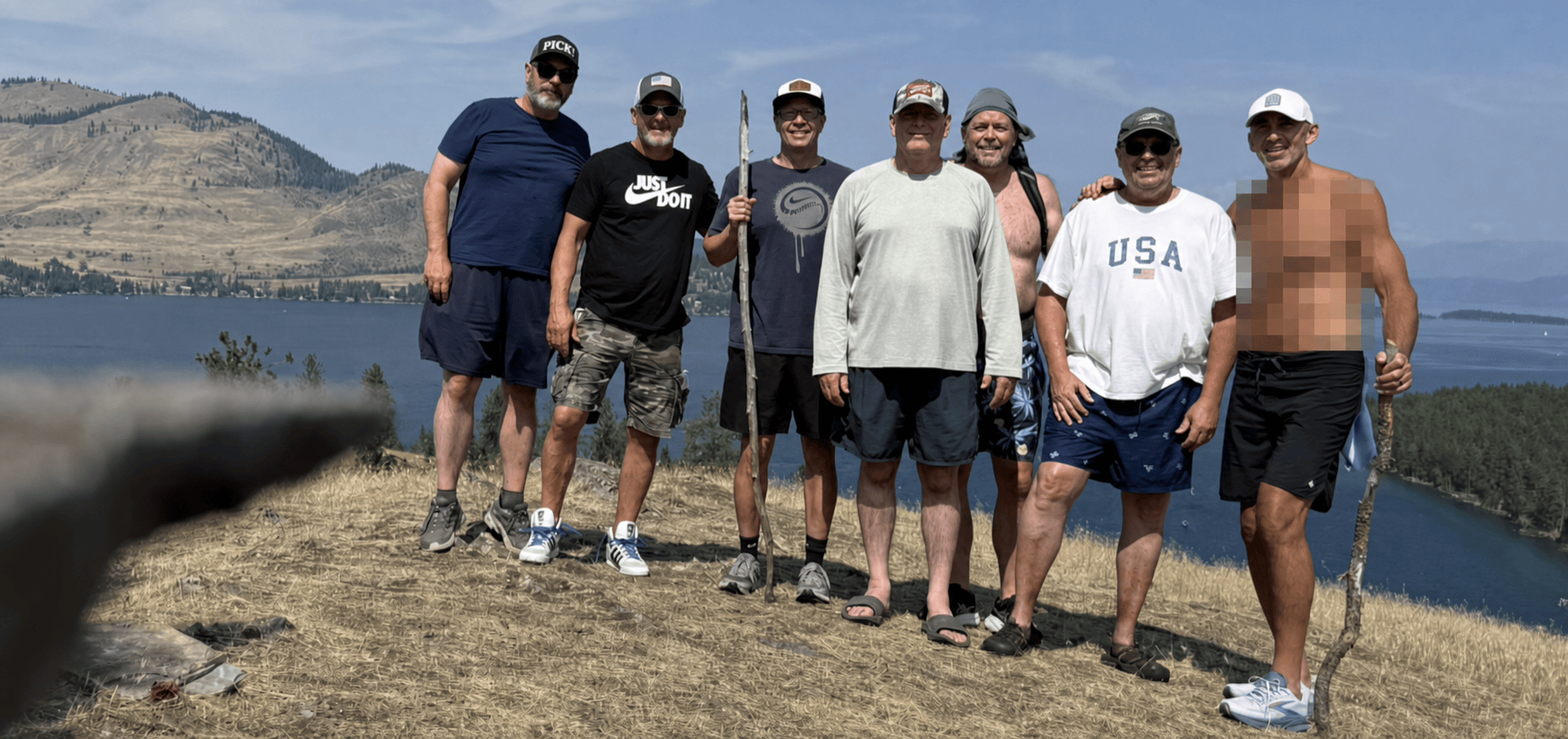
The Boyz above Flathead Lake after climbing Wild Horse Island
A special group of men has been part of my life since we were barely old enough to call ourselves men.
We met during our freshman year of college. We had little money, limited wisdom and no idea where our lives would eventually take us. We knew one another before careers, marriages, children, grandchildren and all the other responsibilities that gradually attach themselves to a person’s name.
The year was 1985.
Nearly everything around us has changed since then, but the bond we share today is no less real than it was when we first became friends. Time has added years to our faces and history to our conversations, but it has not taken away the ease of being together.
There is something rare about spending time with people who knew you before you became whoever the rest of the world believes you to be.
We recently converged on Polson, Montana, for a retreat with the Boyz. We rented a large house on the southern shore of Flathead Lake. The accommodations were more than adequate, but the real attraction was beyond the windows. The yard ended at the water, where a dock waited for the pontoon boat we had rented.
At least, that had been the plan.
The first afternoon brought wind—the kind that makes the surface of a lake look angry. Waves of three and four feet rolled across the water, removing any temptation to pretend enthusiasm was the same thing as sound judgment. The rental boat remained safely tied to the marina dock, and our dock at the house remained empty.
The following morning, the wind was joined by an all-day rain. It was not the passing kind that briefly darkens the sky and then moves along. It settled over the lake, soaked the lawn and kept us inside.
So we talked.
Cards were shuffled, dealt, gathered and shuffled again. Old stories surfaced and were corrected by the other eyewitnesses. Events that one person remembered with absolute confidence were amended by six people who remembered them differently. We caught up on the parts of life that do not fit easily into occasional telephone calls or group messages. We laughed at things that would have required far too much explanation for anyone else to understand.
The weather had kept us from doing what we planned, but it had not kept us from what we had come to do.
We had come to be together.
The next morning arrived with no rain, a light breeze and noticeably improved dispositions. We drove the five minutes to the marina and boarded the pontoon.
Before we left, the attendant showed us a map of the lake and pointed out areas where shallow water, rocks and submerged obstructions required particular attention. Repairs resulting from shallow water that has not been properly respected can add up quickly.
Unfortunately, I have some experience with that equation.
The lake was still unsettled enough that we decided against immediately crossing its open water. Instead, we turned into the Flathead River and headed downstream toward the Séliš Ksanka Ql̓ispé Dam, formerly known as Kerr Dam, roughly four or five miles away.
Several hundred yards into the river, nearly everyone decided to jump overboard for a swim.
Everyone except me.
I do not particularly enjoy getting wet, and with other boats moving along the river, someone needed to remain aboard and maintain control of the vessel. I was willing to make that sacrifice.
Once everyone had climbed back aboard, we continued toward the dam. We were not in a hurry. Familiar music from our college years played through the speakers, and the conversation moved easily between the present and a time when those songs had been new.
Before long, we reached the first shallow area the attendant had marked on the map. The channel narrowed, and the color and texture of the water began to change. Whatever waited beneath the surface could not always be seen clearly from the helm.
Without being asked, the Boyz moved into position.
Several stood along the port side while others watched from starboard. They leaned over the rails, studied the water and called out what they saw. One warned me away from a shallow patch. Another identified the deeper channel. Someone else watched behind us to make certain the stern and motor cleared what we had already passed.
I remained at the controls, but I was not navigating alone.
We made it through without touching anything expensive and continued toward the dam. Once we arrived, we stayed for a while with no particular agenda. We floated, listened to music, looked at the surrounding hills and enjoyed having nowhere else we needed to be.
Later, we began searching for a rope swing we had been told was somewhere along the river. After a little looking—and more assistance from the men stationed along both sides of the boat—we found it.
A couple of our crew members decided to try it. Unfortunately, the length of the rope had not been calculated with their equally long frames in mind. Their feet entered the water well before the swing reached the point at which they might have risen gracefully into the air, stealing most of their momentum and nearly all the elegance from the attempt.
They plowed into the river rather than soaring above it.
The rest of us offered the “encouragement” close friends are uniquely qualified to provide.
We eventually pulled onto shore for lunch, and the men along the rails once again watched the depth and guided the boat safely in and out. By then, the arrangement had become almost instinctive. Whenever the water became uncertain, everyone found a place from which he could see and offered what he knew.
After lunch, we decided to make the longer journey to Wild Horse Island.
The ride gave us time to appreciate the scale of Flathead Lake and the mountains rising around it. When we reached the island, we began searching for a place to go ashore. The first landing appeared inviting from a distance, but as we approached, submerged pylons and deadfall began appearing beneath the surface.
It looked like a minefield.
There may have been a safe route through it, but finding that route would have required risking the boat to prove it existed. We turned around.
That decision did not diminish the day. It simply preserved our ability to continue it.
We followed the island’s shoreline until we found a designated landing site and a trail climbing toward higher ground. We had come prepared for a day on the water, not a hike. None of us had brought water, and Rod’s only footwear was a pair of rubber slides better suited to crossing a pontoon deck than climbing Wild Horse Island. It was not an impressive display of preparation, but the opportunity to climb together again was too difficult to resist.
So we began climbing.
The trail rose away from the lake through dry grass and scattered ponderosa pines. As we gained elevation, the water widened beneath us and the mountains appeared beyond it. The climb awakened memories of the times several of us had hiked and hunted together years before, when steep trails had required considerably less discussion.
Eventually, we stood together above the lake, no longer the young men who had first become friends but still recognizably the same group. The photograph from the summit shows seven men standing side by side, some holding walking sticks acquired along the way. It records where we were that afternoon.
Looking at it later, however, I realized that the image that best explains our friendship was never photographed.
It happened earlier, when the channel narrowed and six men moved toward the rails.
From the helm, I could see ahead, but not everything. The boat itself obscured hazards close to the hull, and glare concealed what waited beneath the surface. The Boyz could see the water from angles I could not, so they leaned over the sides and called out what they saw.
A little to port.
Stay right.
There is something beneath us.
The channel is clear ahead.
The wheel and the clearest view were not always in the same place.
There is something important in that distinction. Being responsible for a decision does not mean we possess all the wisdom needed to make it. The best friends understand this. They do not grab the wheel or demand control. They move to where they can see, tell us the truth about what is there and trust us to steer.
For most of my life, I thought enduring friendship was built primarily by looking back—remembering old stories, familiar songs and younger versions of ourselves. Those things matter. But perhaps friendship endures because it also looks ahead.
The summit photograph is the picture we will keep.
The image I will remember is six friends leaning over the rails.
They were not looking at me.
They were looking where I could not.
Come to think of it, we have been doing that for one another since 1985.
Until next time,
George
If this reflection brought someone to mind, perhaps share it with them. If you enjoyed it, I hope you’ll stay awhile, read a few more and consider subscribing.